
June-July 1999 saw some of the most bitterly fought battles in the Kargil War. Colonel Gaurav Chaturvedi looks back on those days -- and the extraordinary saga of the men he fought alongside.

The once promising YRF Spy Universe, which delivered Bollywood's first Rs 500 crore grosser with Pathaan, is now grappling with an uncertain future as recent releases like Alpha and War 2 fail to ignite the box office.
US President Donald Trump on Friday (local time) announced a three-day ceasefire between Russia and Ukraine, noting that the temporary truce coincides with Russia's Victory Day celebrations commemorating the then-Soviet Union's role in World War II.

Chief Justice of India Surya Kant highlighted the rapid integration of Artificial Intelligence into arbitration practices, expressing concerns about its accuracy, authenticity, and ethical use. He stressed the need for mandatory disclosure when generative AI is used in preparing legal documents and reports, advocating for shared standards to manage deepfakes and AI-generated material. The CJI also encouraged embracing AI for efficiency in tasks like e-discovery while preserving core arbitration principles.

It's only July but the South Korean drama scene is brimming with action and adrenalin.

Interim All India Tennis Association (AITA) President Chintan Parikh has accused court-appointed administrator Justice (Retd.) Gita Mittal of financial exploitation and procedural bias, alleging that her actions are draining the sports body's finances and compromising its autonomy.
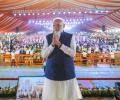
This is the time for India to plan forward fully, with the goal of Atmanirbharata, and energy security. The Persian Gulf is no longer a reliable source, points out Rajeev Srinivasan.

Wolfgang Petersen's Troy is grand, star-studded and visually impressive, but it never quite lives up to the epic that inspired it.

The question nobody seems to ask is why a democracy should be silent when many of its citizens are concerned about the way the US is deviating from its traditional ways of consultation, cooperation and collaboration and moving away from traditional allies, asks Ambassador T P Sreenivasan.

Olympic medallist Mirabai Chanu secured her third consecutive Commonwealth Games gold, breaking records in the women's 48kg weightlifting. Rishikanta Singh and Raja Muthupandi also added silver medals, contributing to India's growing tally at the Games.

Companies are already diversifying sourcing, raising prices, and reworking operating models as the disruption drags on.

A derogatory 'cockroach' remark by Chief Justice Surya Kant during a Supreme Court hearing inadvertently sparked a nationwide student movement, transforming an insult into a powerful symbol of protest that led to Union Education Minister Dharmendra Pradhan's resignation.

The United States has paused a proposed USD 14 billion arms sale to Taiwan due to concerns about maintaining sufficient munitions for potential conflicts, particularly in light of the ongoing situation with Iran.
Disciplined investors who ignore short-term fear build significant long-term wealth, notes Ramalingam Kalirajan

It was left to an incensed Gen Z to show the rest of India that enough was enough, and that the time had come to shatter the fear psychosis generated by the government's authoritarian approach to protests and criticism, points out M R Narayan Swamy.

US President Donald Trump on Friday (local time) touted his claims of ending multiple global conflicts after he took charge of the White House and expressed hope that the ongoing Russia-Ukraine war could become the next one resolved, saying he would "love to" make it the tenth.

The Maharashtra State Electricity Distribution Company Limited (MSEDCL) has successfully restored electricity to over 2 lakh consumers in the flood-affected Vasai-Virar region within 12 hours of floodwaters receding, deploying boats to inspect submerged transformers and repair damaged infrastructure.

US Senator Lindsey Graham passed away of a cardiac arrest a few hours after these photographs were taken.

History is rarely decided by who has the biggest weapons, but by who has the better process. The same rule applies to investing, says Ramalingam Kalirajan.

Four Indian nationals have been killed in an attack on the vessel MV Golden Leo during departure from the port of Odesa in Ukraine on Sunday evening, while one is critically injured.

'These are children of our own country; they must be heard': Param Vir Chakra Awardee Honorary Captain Yogendra Singh Yadav.

The Indian government has informed the Lok Sabha that the income-tax return (ITR) e-filing portal is functioning in a 'largely stable and efficient manner' despite a significant increase in traffic during the peak filing season. However, it acknowledged transient technical issues and disclosed that contractual penalties have been imposed on Infosys for project delays and service-level agreement failures.

Argentina's football players displayed a political banner claiming "The Falklands are Argentine" after their World Cup semi-final win against England, potentially violating FIFA's code of conduct.

Anupam Kher and Naseeruddin Shah find themselves in a public war of words, reigniting their long-standing feud over Shah's 'clown' remarks and Kher's political affiliations.
The National Investigation Agency (NIA) has filed a supplementary chargesheet naming Lashkar-e-Taiba (LeT) chief Hafiz Saeed as an accused in the Pahalgam terror attack, charging him with waging war against India and hatching a cross-border conspiracy.

The Kremlin on Tuesday said Ukrainian President Volodymyr Zelenskyy could travel to Moscow for talks if he is prepared for "responsible and serious" discussions aimed at resolving the Ukraine conflict, while noting that no official communication channels currently exist between the two sides.

Argentina's hopes of securing back-to-back World Cup titles were dashed after a 1-0 extra-time defeat to Spain in the final, leaving fans in Buenos Aires with a "bitter sensation" despite acknowledging Spain's strong performance.

The United States on Saturday (local time) launched a third round of strikes against Iran after alleging that Iran's Islamic Revolutionary Guard Corps (IRGC) attacked the Cyprus-flagged container vessel M/V GFS Galaxy in the Strait of Hormuz.

C Joseph Vijay's Jana Nayagan is not just a film but a potent political statement, strategically crafted to align with his political aspirations and claim the legacy of M G Ramachandran, notes Saisuresh Sivaswamy.

That means making it easier to invest, protecting investors through predictable rules, and avoiding policy reversals after investments have been made, notes Rajeswari Sengupta.

Rebel Trinamool Congress MP Arup Chakraborty on Monday said the breakaway faction is trying to "rectify" the party, and would fight for the control of its election symbol, even as the Mamata Banerjee-led outfit termed the move illegal under the anti-defection law.

A US-Iran memorandum of understanding is set to be signed, outlining sanctions relief, the reopening of the Strait of Hormuz, and a 60-day negotiation window for Iran's uranium enrichment, but US President Donald Trump has underscored the deal's conditional nature, warning of military action if Tehran fails to comply.

Paraguayan Senator Celeste Amarilla escalated her feud with French footballer Kylian Mbappe, calling him a "son of a b****" during a Senate speech. This follows an incident where Mbappe allegedly refused to shake goalkeeper Orlando Gill's hand after a FIFA World Cup match. Amarilla also claimed Mbappe called her "despicable," while France coach Didier Deschamps stated the controversy hasn't affected Mbappe's focus.

Gujarat's Anti-Terrorist Squad (ATS) has arrested eight alleged members of the Pakistan-based terror outfit Jaish-e-Mohammed (JeM), including two teenagers, for attempting to establish an active terror network across Gujarat and Madhya Pradesh. The accused face charges under the Unlawful Activities (Prevention) Act and Bharatiya Nyaya Sanhita.

Atlanta Police are implementing enhanced security measures for the World Cup semi-final between Argentina and England, a match deemed high-risk due to the historical animosity between the two nations.

As Sonam Wangchuk's hunger strike enters its 19th day, critics question why the government has remained silent despite mounting concerns over student welfare, observes Harishchandra.

Donald Trump announced he is replacing the 20% reimbursement fee for securing the Strait of Hormuz with massive trade and investment deals from Gulf States into the United States, while maintaining a full blockade on Iranian ship traffic.

From Satyameva Jayate to Mastiii 4, Milap Zaveri's films may divide critics, but ranking them can prove to be even more challenging than watching them.

Messi, who said he was thoroughly enjoying the ride at his sixth World Cup and giving no thought to retirement, was looking forward to locking horns with 2010 champions Spain in New Jersey on Sunday.

Millions of people, including international representatives, are expected to attend the funeral of Iran's Supreme Leader Ayatollah Ali Khamenei in Tehran. His death occurred at the start of the US-Israel war on Iran. US President Donald Trump announced a week-long pause in bombing for the funeral, while India was represented by Governor Syed Ata Hasnain and MoS External Affairs Pabitra Margherita. The event is anticipated to be one of the largest gatherings in Iran's history, with ceremonies delayed due to security concerns.
